If you have ever watched the TV game show The Price is Right, played a physics minigame, or visited an arcade, you already know the magic of Plinko.
A contestant drops a flat round chip from the top of a big vertical board filled with rows of metal pegs. With every peg it strikes, the chip bounces left or right with a satisfying clack-clack-clack.
Every single bounce looks completely wild and unpredictable. Yet, when you drop dozens of balls, something amazing happens:
The balls almost always pile up into a smooth, tall mound right in the middle slots!
Why does that happen? Why do so few chips ever reach the far left or far right corners?
Here is how Plinko works, explained in simple, friendly English.
1. Francis Galton and the Famous “Galton Board”
In 1873, a British scientist named Sir Francis Galton wanted to show people that order can come out of complete randomness.
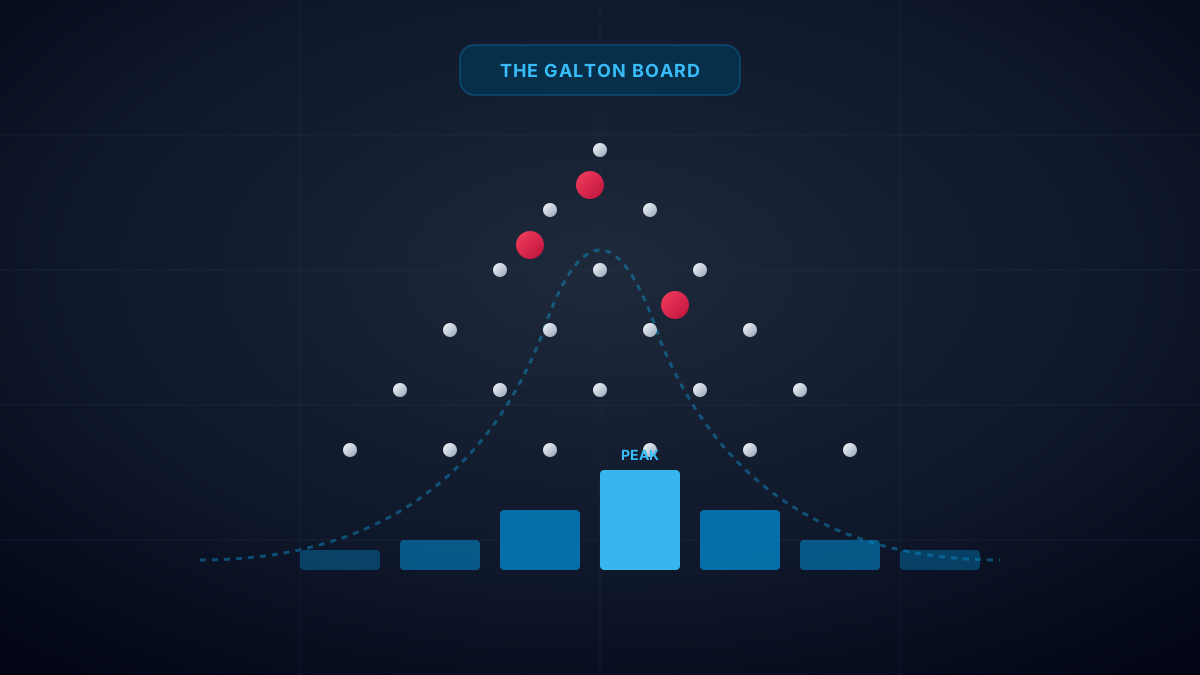
He built a wooden board with rows of pins and named it the Quincunx (today we call it a Galton Board or a Plinko Board).
When he poured hundreds of tiny metal pellets through the top funnel, each pellet bounced left or right by chance. But when they reached the bottom bins, they formed a perfect bell-shaped curve every single time!
2. Every Peg Is a 50/50 Choice
To see why the balls love the center, imagine a ball falling through just 4 rows of pegs:
Every time the ball hits a peg, it has two choices:
- Bounce Left (L) (50% chance)
- Bounce Right (R) (50% chance)
                 [ Drop Ball Here ]
                         ●
                        / \
                       /   \
                      ●     ●
                     / \   / \
                    ●   ● ●   ●
The Path to the Edges is Super Rare
- To land in the far-left slot, the ball must bounce Left on every single peg:
L-L-L-L. - There is only 1 single way for that to happen out of 16 possibilities ($6.25%$).
- To land in the far-right slot, it must bounce Right on every peg:
R-R-R-R(also only $6.25%$).
The Path to the Center Has Many Ways!
To land in the exact middle, the ball just needs an equal number of Left and Right bounces.
Look at all the different ways that can happen:
Left - Left - Right - RightLeft - Right - Left - RightLeft - Right - Right - LeftRight - Left - Left - RightRight - Left - Right - LeftRight - Right - Left - Left
There are 6 different paths that lead straight into the center!
That means the middle slot is 6 times more likely to catch a ball than the outside edge slots!
3. The “Bell Curve”: Why Real Life Copies Plinko
When you increase the board from 4 rows to 16, 32, or 50 rows of pegs, this effect becomes even stronger.
Statisticians call this shape the Normal Distribution or the Bell Curve:
- About 68% of all balls will land in the center slots.
- About 95% of all balls will land in the middle area.
- Less than 1% will ever reach the extreme outer corners.
This same Bell Curve appears all over the real world—such as human heights, shoe sizes, exam scores, and weather patterns. Most things cluster near the average (the middle), while extreme highs and extreme lows are rare!
4. How Plinko Game Shows Use This Math
Game designers understand this curve completely. That is why:
- The Center Slots: Usually offer safe, steady, moderate point values.
- The Outer Edge Slots: Offer giant jackpots (like $10,000 or $50,000) because the game designers know that very few chips will ever manage to bounce all the way to the corner!
Quick Tip for Playing Plinko
- If you want a consistent, safe win, drop your chip dead center.
- If you want to aim for the huge outer jackpot, drop your chip near the side—though be warned: balls naturally drift back toward the center as they fall!
Want to see the physics in action?