Whether you are organizing a weekend Super Smash Bros or Valorant gaming tournament, setting up a local pickleball or soccer league, or hosting an office debate over the “Best Fast Food French Fries,” tournament brackets are the ultimate way to crown a champion!
A tournament bracket transforms chaotic competition into clean, visual, high-stakes drama. Every match has clear consequences, every round builds anticipation, and at the end of the line, one undisputed winner lifts the trophy.
However, organizing brackets manually on paper or in messy spreadsheets is tedious. What do you do when you have 11 teams instead of 16? How should top seeds be arranged? What is the difference between single and double elimination?
In this complete guide, we break down tournament bracket formats, explain seeding math in simple, friendly English, and show you how to use a free tournament bracket generator with zero hassle!
1. The 4 Major Tournament Bracket Formats
Choosing the right tournament format depends on how much time you have and how many games your participants want to play:
[ Single Elimination ] ──> Fast, high drama (1 loss = OUT)
[ Double Elimination ] ──> Forgiving (Requires 2 losses, has Losers' Bracket)
[ Round Robin ]        ──> Comprehensive (Everyone plays everyone)
[ Swiss System ]       ──> Balanced (Paired by match record each round)
1. Single Elimination (Knockout)
- The Rule: Win and advance, or lose and go home!
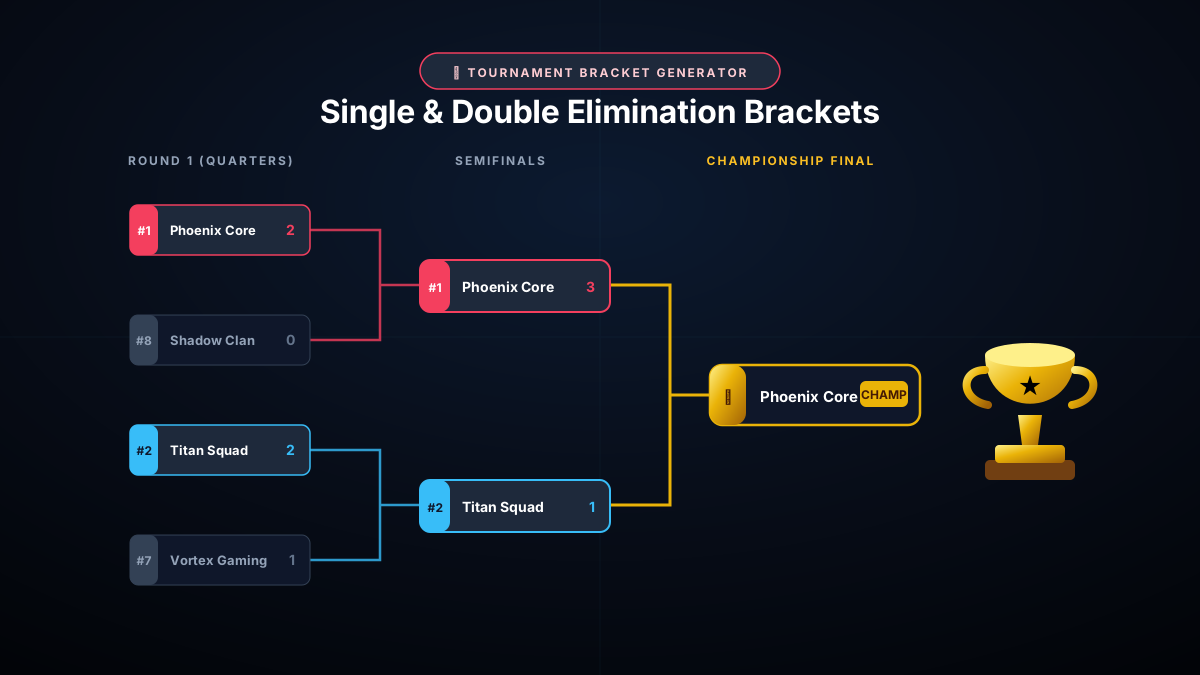
- Why it’s great: It is the fastest, cleanest, and most dramatic format. It is the format made famous by NCAA March Madness and the FIFA World Cup knockout stages.
- Total Matches Needed: Exactly $N - 1$ matches (e.g. 16 teams require exactly 15 matches to crown a champion).
2. Double Elimination
- The Rule: A team is only eliminated after losing two matches.
- How it works: When a team loses in the Winners’ Bracket, they drop into a parallel Losers’ Bracket. If they keep winning in the Losers’ Bracket, they can fight all the way to the Grand Finals for a revenge rematch!
- Why it’s great: It guarantees every player gets to play at least two matches, preventing an unlucky first-round draw from ruining a good contender’s day. Widely used in esports like fighting games (FGC) and Rocket League.
3. Round Robin
- The Rule: Every contender plays a match against every other contender in their pool.
- Why it’s great: It is the most statistically fair format because flukes don’t end a tournament. Ideal for soccer group stages, chess tournaments, and recreational summer leagues.
4. Swiss System
- The Rule: Competitors play a fixed number of rounds, facing opponents with identical or very similar win-loss records (e.g., 2-0 teams play 2-0 teams; 0-2 teams play 0-2 teams).
- Why it’s great: Nobody is eliminated early, and matches get progressively closer and more competitive every round. Widely used in chess, Magic: The Gathering, and CS2 Majors.
2. The Golden Rule of Brackets: Powers of 2 & “Byes”
Have you ever wondered why tournament brackets always have 4, 8, 16, 32, or 64 teams?
In mathematics, a clean knockout tournament requires a power of 2 ($2^n$):
- 4 teams = 2 rounds (Semifinals $\to$ Finals)
- 8 teams = 3 rounds (Quarterfinals $\to$ Semifinals $\to$ Finals)
- 16 teams = 4 rounds
- 32 teams = 5 rounds
What If You Have an Odd Number of Teams? (The “Bye” Explained)
What happens if only 11 people sign up for your tournament? 11 is not a power of 2!
To solve this, organizers use “Byes”:
- Find the next highest power of 2. For 11 teams, the next power is 16.
- Subtract your team count: $16 - 11 = \mathbf{5\text{ Byes}}$.
- The top 5 seeded teams automatically skip Round 1 and advance straight to Round 2!
- The remaining 6 teams battle in Round 1 for the remaining 3 spots.
- From Round 2 onward, exactly 8 teams remain, and the bracket runs perfectly smooth!
3. How Bracket Seeding Works
In competitive sports and esports, seeding ranks contenders from strongest (#1) to weakest.
The purpose of seeding is to protect the highest-performing teams from knocking each other out in the opening round.
In a classic 16-team tournament bracket, the matchups are paired so that the sum of the seeds equals $N + 1$ (which is $17$):
- Match 1: Seed #1 vs Seed #16 ($1 + 16 = 17$)
- Match 2: Seed #8 vs Seed #9 ($8 + 9 = 17$)
- Match 3: Seed #5 vs Seed #12 ($5 + 12 = 17$)
- Match 4: Seed #4 vs Seed #13 ($4 + 13 = 17$)
If all top seeds win, Seed #1 will eventually play Seed #2 in the Grand Finals!
4. Popular Non-Sports Brackets (Pop Culture & Office Polls)
You don’t need a sports league to enjoy tournament brackets! Some of the most viral and engaging social events use tournament bracket templates to settle fun pop-culture debates:
- Food & Dining: “Best Fast Food Burger”, “Best Pizza Topping”, “Ultimate Potato Chip Flavor”.
- Movies & TV: “Greatest Marvel Movie”, “Best 90s Sitcom”, “Scariest Horror Film”.
- Gaming & Anime: “Best Anime Protagonist”, “Greatest Video Game Soundtrack”, “Top Pokémon”.
- Workplace & Classroom: “Best Office Snack”, “Favorite Book of the Year”, “Funniest Meme”.
On PickLab’s Tournament Bracket Maker, you can paste any custom list of candidates, vote on matches click-by-click, or click “Simulate” to watch an impartial randomizer crown the champion!
Frequently Asked Questions (FAQ)
How does this tournament bracket generator work?
Choose your tournament size (4, 8, 16, or 32 teams), paste or type your team names, and click to start. You can advance winners manually with one click or simulate rounds with fair hardware randomness.
Is this tournament bracket maker 100% free?
Yes! PickLab Bracket Maker is completely free with zero sign-up, zero advertisements, and no restrictions on tournament size or roster customization.
What is the single-elimination tournament format?
In single-elimination (knockout), the loser of every individual match is immediately eliminated, while the winner advances to the next round until one grand champion is crowned.
How does double-elimination differ from single-elimination?
In double-elimination, a team must lose twice before being knocked out. Teams that lose their first game drop into a Losers’ Bracket and can still battle back to reach the Grand Finals.
Can I create tournament bracket templates for fun debates (e.g. food, movies, music)?
Yes! Bracket tournaments are wildly popular for office debates and social media voting on Best Fast Food, Favorite Marvel Movie, Top Video Games, or 90s Music showdowns.
Can I customize team names, seeds, or contenders?
Yes! Click the ‘Edit Roster’ button to paste your custom team names, player gamertags, or school rosters. You can shuffle seeds randomly or rank teams from #1 to #32.
Can I add pictures or emojis to the tournament bracket?
Yes! You can include emojis directly next to team names (e.g., 🦁 Lions vs 🦅 Eagles) and take high-resolution screenshots of the completed bracket to share on Discord, Twitter, or Instagram.
How does bracket seeding work?
Seeding arranges matchups so the highest-ranked teams don’t play each other in the early rounds (traditionally #1 plays #16, #2 plays #15). PickLab lets you apply traditional seeding or randomize with one tap.
Can I print or save my completed tournament bracket?
Yes! The interactive bracket layout is fully responsive and printer-friendly. You can print to PDF, take clean full-screen screenshots, or copy results to Discord, Slack, or Google Sheets.
How does the instant match simulation work?
Clicking ‘Simulate’ triggers an unbiased randomizer powered by your device’s Web Crypto hardware entropy (crypto.getRandomValues). It simulates each round in seconds and awards the winner with victory confetti.
Ready to run your tournament?