When you open a brand-new box of playing cards, they always start in perfect factory order: Ace to King of Spades, Hearts, Diamonds, and Clubs.
Before dealing a game of poker, blackjack, or Uno, someone starts shuffling. Usually, they shuffle the deck two or three times, cut the deck, and start dealing.
It looks mixed up to our eyes. But mathematicians tested this, and their discovery shocked card players:
If you only shuffle 2, 3, or 4 times, the cards are still mostly in their original order!
So, how many times do you actually need to shuffle? The answer is proven by math: exactly 7 riffle shuffles.
1. Why 7 Is the Magic Number
A riffle shuffle is the classic method where you split the deck into two halves and let the cards zip together with your thumbs.
In 1992, two mathematicians named Dave Bayer and Persi Diaconis used supercomputers and probability formulas to track what happens to a 52-card deck after every shuffle:
| Number of Riffle Shuffles | How Mixed Up Is the Deck? | Can Players Track Cards? |
|---|---|---|
| 1 to 3 | Not mixed at all | Very easy to track card clumps |
| 4 | Still heavily ordered | Good card players can guess next cards |
| 5 | Halfway there | Patterns still remain |
| 6 | Almost mixed | Getting close to random |
| 7 | Fully Random! | The deck is completely mixed up |
| 8 or 9 | Extremely random | Only tiny improvements |
The “Cutoff Point”
Notice what happens at number 7:
- At 5 or 6 shuffles, long sequences of cards from the previous round are still stuck together.
- Right at the 7th shuffle, those patterns suddenly break apart into complete randomness.
If you are hosting a poker night or family board game, make sure whoever deals shuffles the cards at least 7 times to keep the game completely fair!
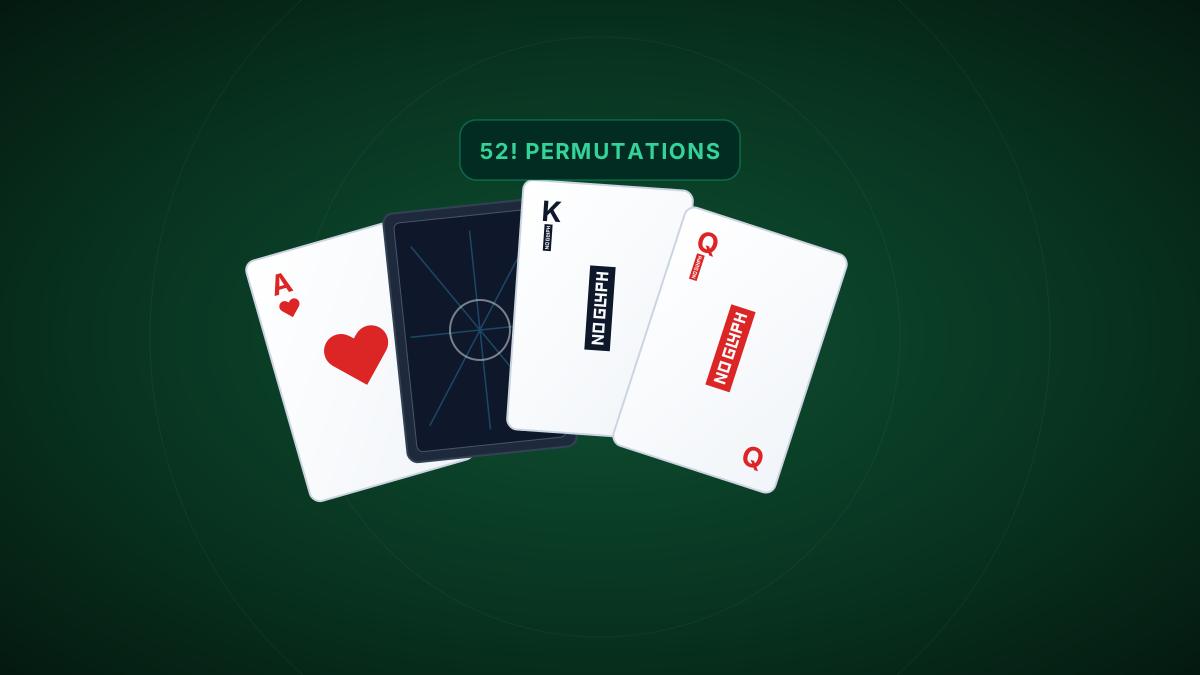
2. The Mind-Blowing Size of 52 Cards ($52!$)
Here is one of the most incredible facts in all of mathematics:
How many different ways can you arrange 52 cards?
To find out, you multiply:
$$52 \times 51 \times 50 \times 49 \dots \times 3 \times 2 \times 1$$
The resulting number is so huge that it is almost impossible for our brains to imagine:
$$\approx 80,000,000,000,000,000,000,000,000,000,000,000,000,000,000,000,000,000,000,000,000,000,000$$
(That is an 8 followed by 67 zeros!)
What Does That Mean in Real Life?
- There are roughly $10^{50}$ atoms that make up the entire planet Earth.
- The number of possible card deck orders is one quintillion times bigger than all the atoms on Earth!
- That means: Every time you shuffle a deck of cards 7 times, it is virtually certain that no human being in the entire history of the world has ever held that exact order of cards before. And no one ever will again!
3. What About Sliding Cards from Hand to Hand? (The Overhand Shuffle)
Many casual players do not riffle shuffle. Instead, they hold the deck and slide small packets of cards into their other hand (the overhand shuffle).
How many times do you need to do that?
Mathematicians studied this too, and the answer is bad news:
- Because overhand shuffling drops big chunks of cards together without mixing the individual cards, you need to do it about 10,000 times to match 7 riffle shuffles!
- Doing 10,000 overhand shuffles would take more than an hour of continuous hand cramps.
The Best Casual Alternative: The “Casino Wash”
If you cannot do a riffle shuffle, do what casino dealers do:
- Spread all 52 cards face-down on the table.
- Swirl them around in messy circles with both hands for 30 to 45 seconds.
- Gather the cards back up into a stack.
This simple “washing” motion completely breaks up clumps and randomizes the deck quickly and easily!
4. Digital Shuffling: Instant & 100% Fair
In real life, bent cards, sticky fingers, and uneven thumbs can still cause accidental patterns.
On PickLab, our Card Drawer & Deck Simulator uses a famous computer algorithm called the Fisher-Yates Shuffle.
Instead of waiting for 7 manual shuffles, it mixes the entire deck instantaneously in less than 1 millisecond using true hardware randomness. Every deal is 100% fair with zero human bias.